Allergens Testing: A Vital Process for Ensuring Product Safety and Legal Compliance

Effective allergen management is a legal requirement, and failing to do so can potentially have devastating consequences. One Scientific – a Tentamus Company, offers ELISA- and PCR-based services for detection of allergens within a product, ensuring food production lines remain compliant and supply risk is minimised.
By Urte Balseviciute, Molecular Laboratory Manager at One Scientific – a Tentamus Company (UKAS accredited testing laboratory No. 2048)
The testing of food items for allergens is a vital part of the quality assurance process and ensures that the potential for harm to consumers caused by the product is minimised. If a consumer eats an item that contains an ingredient to which they are allergic, there is the potential for tragic consequences. One of the most famous cases is that of Natasha Ednan-Laperouse, who died after eating a baguette from Pret a Manger in Heathrow Airport. Natasha, who had a severe allergy to sesame, suffered a fatal anaphylactic reaction after ingesting sesame seeds that had been baked into the bread dough. This tragic incident resulted in ‘Natasha’s law’, which requires all foods – both those prepared on premises and those pre-packaged for sale – to display a full ingredients list, with the top 14 allergens clearly highlighted.
This short piece will outline how One Scientific – a Tentamus Company (UKAS accredited testing laboratory No. 2048), works with clients to provide chemical and microbiological testing services, including analytical methods, for detection of allergens within a product. However, before we discuss the testing services we offer in more detail, what allergens are and how they can cause extreme reactions in the body will be outlined.
Allergens: What is it that causes an allergic reaction?
An allergy occurs when the body reacts to an allergen that is normally completely harmless – usually pollen, dust, insect bites or animals – resulting in an immunological response. In some cases, symptoms can be mild, for example a runny nose or sneezing, red or watering eyes, pain or tenderness, but in other cases the body’s response can be serious, and in extreme situations can result in anaphylaxis, with the potential for death.
The biological cause of this allergic reaction is the presence of a substance (or an allergen) that the body perceives to be a threat, which elicits an immunological response. Allergens can be proteins – for example in the case of nut or shellfish allergies – or a specific chemical compound, such as sulfur dioxide gas (SO2) or sulfites. A food allergy develops when an individual eats, touches or inhales a particular protein or chemical that results in the body’s’ immune system forming Immunoglobulin E antibodies (IgEs), a class of allergen-specific antibodies.
Food allergens and UK/EU law
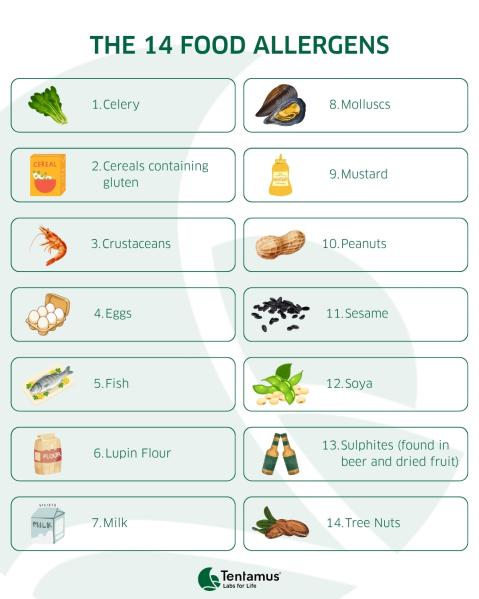
Within UK and EU law, there are 14 allergens that need to be declared, and clearly communicated to consumers, when present in food products. These allergens are: celery, cereals containing gluten, crustaceans, eggs, fish, lupin, milk, molluscs, mustard, nuts, peanuts, sesame seeds, soya, and sulfur dioxide/sulfites.
Testing for allergens
The fact that allergens are typically proteins means that they each have their own biological or chemical “fingerprint”, which feeds into how they can be detected. Detection methods commonly target either the allergenic proteins themselves, or the DNA of the source organism. There are several modes of allergen detection, including ELISA assays, PCR, LC-MS/MS and lateral flow tests. Of these, ELISA and PCR are the most widely used because of their balance of specificity, accuracy and the associated costs. One Scientific – a Tentamus company, focusses exclusively on ELISA and PCR testing.
ELISA assays
Enzyme-Linked Immunosorbent Assays (ELISA) are reliant on the specific binding between antigens and antibodies. In food allergen testing, allergens (which are typically proteins), are detected through highly specific interactions with the antibodies directed against them. Depending on the ELISA format, either the antigen or a capture antibody is immobilised onto a solid surface such as a microplate well. The sample for analysis is then added to the assay plate, allowing the target antigen (if present) to bind to the immobilised capture antibody in sandwich ELISA formats, or be detected by antibodies in other assay designs, including competitive ELISA formats where the sample antigen competes with a labelled antigen for antibody binding sites. Detection may occur using a directly enzyme-labelled antibody (direct detection), or an unlabelled primary antibody followed by an enzyme-linked secondary antibody (indirect detection). The resulting enzyme–substrate reaction produces a measurable signal, typically a colour change, that can be quantified using spectrophotometry.
PCR
Polymerase Chain Reaction (PCR) is also commonly used in food allergen testing, and relies upon DNA detection from the target species rather than protein detection. Within a PCR-based test, DNA is extracted from the food containing the allergen. This DNA is then heated, so it denatures and, in doing so, separates into two single-stranded pieces of DNA. The next stage is to resynthesise new strands of DNA, using the original DNA strands as a template, with primers and a heat-stable enzyme. The DNA is subjected to repeated cycles of denaturation, primer binding and replication – as many as 30 or 40 times – giving up to a billion copies of the original DNA sample.
ELISA or PCR: which should I choose?
Whether an ELISA or PCR test is best depends upon the allergen that you’re trying to detect and the food matrix being investigated. However, it’s widely accepted that if an ELISA test is available for an allergen it’s used preferentially because, even if a PCR test gives a positive result for the presence of DNA, it doesn’t mean that protein (allergen) is present, just that the DNA that codes for the protein is present.
That said, there are cases where using PCR may be preferable. This can be due to low protein content of the sample, or when DNA-based detection is more reliable than protein-based methods. For example, heat treatment can denature or degrade allergenic proteins, reducing the effectiveness of ELISA assays. In addition, ELISA methods may be susceptible to cross-reactivity with closely related species, potentially leading to false positive results.
For example, celery is typically difficult to detect using ELISA assays due to the extremely low specific allergenic protein content and poor detectability; because it does not give a strong response in ELISA assays, PCR can be a more suitable alternative for DNA-based detection. In addition, celery can often give cross-reactivity with other plants – for example carrot or parsley due to shared protein families – which can lead to false positives. Another example of cross-reactivity is mustard, where other members of the family Brassicaceae, such as rapeseed, may give a false positive under ELISA testing. In these circumstances, PCR avoids this type of protein cross-reactivity as it is a DNA-based detection method, although like all analytical methods, it must be carefully controlled to ensure accuracy.
The key to successful allergen testing is to know which allergen you are looking for and then devise a suitable test accordingly. The team at One Scientific - A Tentamus Company are able to help and advise, if necessary.
When should I undertaken allergen testing?
It’s a good idea to undertake allergen testing if there is a risk that allergens that were previously absent may now be present. For example, during a change of ingredients or supplier, changing formulations, cleaning procedures or equipment, if auditors require it, or if switching a production line from one process to another, such as a gluten-containing process to a non-gluten-containing process, or when handling a completely different allergen. In fact, switching process lines from one product to another can be a key point at which to undertake testing, especially if an allergen was used in the previous process that is known to be difficult to remove. For example casein, a protein found in milk and dairy products, is known to adhere strongly to surfaces.
Allergen swabbing for environmental monitoring
Allergen swabbing is a key factor for environmental monitoring within a food manufacturing facility, especially after a cleaning procedure to ensure allergen residues are removed, or production lines switched. An allergen swab comprises a wand, with which the surface is sampled, and a swabbing solution. It’s important that the correct swabbing kit is used for each allergen, as the swabbing solutions are usually allergen-specific. In addition, different swabs are usually used for either samples intended for ELISA testing or PCR analysis.
As a general rule, for both ELISA and PCR testing a 10 cm x 10 cm area is sampled using a zig-zag pattern. After sample collection from the surface, the swab is immediately placed in the swabbing solution, sealed, and then returned to the testing laboratory. Analysis must be completed within 4 days of sample collection for optimal results.
Allergen Testing in the Food Industry: An Absolute Requirement for Legal Compliance
Within the food industry, allergen testing is not a ‘nice to have’, it’s an essential part of UK and EU legal compliance. Alongside this, it’s a vital part of the quality assurance process for consumers, ensuring that the potential for harm caused by a product is minimised.
Contact us today to find out how we can support your legal compliance with allergen testing!
Frequently Asked Questions
Is allergen testing really necessary?
Yes, allergen labelling and management is a legal requirement. Both the UK and EU law require all pre-packaged foods to display a full ingredients list with any of the top 14 allergens present clearly highlighted. While non-prepacked (loose) foods (e.g. bakery items, food from deli counters, and meals in restaurants) do not require an ingredients list, allergen information must still be available to consumers.
How often should I be doing it?
While there is no prescribed time interval for testing, as it is an ongoing process, it should always be carried out if there is a risk that allergens that were previously absent may now be present, e.g. during a change of ingredients or supplier, change of formulation, after a cleaning procedures or cleaning equipment, if auditors require it, or if switching a production line from one process to another, such as a gluten-containing process to a non-gluten-containing process or handling a completely different allergen.
How do I collect swab samples?
Sample collection is simple, and One Scientific – a Tentamus Company, can send you the equipment needed to do so. In its simplest form, it requires taking a surface sample from an area of 10 cm x 10 cm. It’s important that the correct swabbing kit is used for each allergen, as the swabbing solutions are usually specific to a particular allergen. However, we can advise clients on the appropriate swabbing kit that they will need, and the best mode of analysis.
References
[1] Pret allergy death: parents describe final moments with their daughter. Guardian, 29 September 2018. https://www.theguardian.com/society/2018/sep/29/pret-allergy-death-parents-demand-label-laws
[2] Natasha’s Law: Protecting Lives with Clear Allergen Labelling. Natasha Allergy Research Foundation. https://www.narf.org.uk/what-is-natashas-law (Accessed May 2026)
[3] Allergies. National Health Service (NHS), UK. https://www.nhs.uk/conditions/allergies/ (Accessed May 2026)
[4] 14 Allergens. Food Standards Agency, UK. are 14 allergens that need to be declared on food packaging (Accessed May 2026)
[5] Polymerase Chain Reaction (PCR) Fact Sheet. National Human Genome Research Institute. https://www.genome.gov/about-genomics/fact-sheets/Polymerase-Chain-Reaction-Fact-Sheet (Accessed May 2026)